
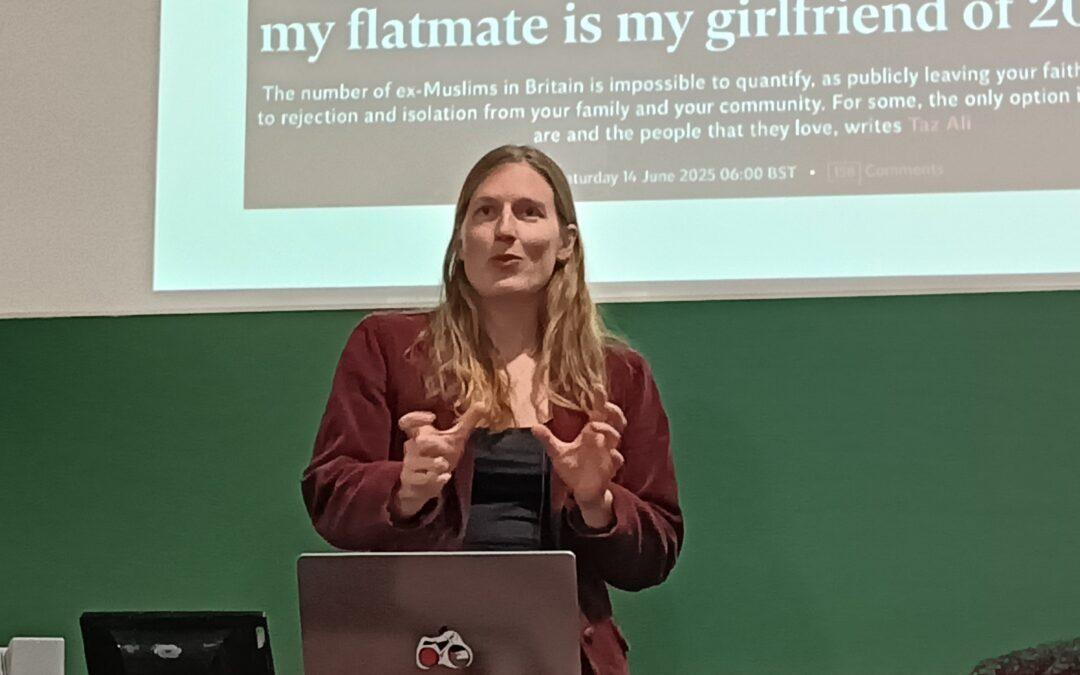
On 3 December 2025 Dr. Lena Richter (Eurac Research, Bolzano, Italy) presented the lecture From “staying in the closet” to “coming out”: Gender, sexuality, and nonreligion in Morocco and its diaspora. The lecture was organised by Lova and the professors of the bachelor’s course Gender, Power and Borders (Gender, Macht and Grenzen) of the Department of Cultural Anthropology and Development Sociology at Radboud University Nijmegen. In May 2024 Richter completed her PhD research project at the Department of Islam, Politics and Society of Radboud University Nijmegen with the dissertation Normalising Nonreligion: Everyday Activism in Morocco and the Moroccan Diaspora. The lecture was focused on the relevance of intersectionality and the parallels in the research on nonbelievers and queer, feminist and critical race theories.
About Lova Network
Lova co-chair Loes Oudenhuijsen opened the lecture by introducing Lova. She mentioned the relevance of a professional organisation for students and academics who care about gender and feminism in the field of anthropology. Some years ago Lena Richter joined the network when the working group Safety in the Field started its activities. This working group is focused on preparing students to prevent and cope with some difficult aspects of ethnographic field work, like sexual harassment.

Tine Davids opened the meeting, accompanied by Loes Oudenhuijsen and Lena Richter
Nonreligion
Before explaining her research topic Richter presented an historical overview of the domain of the anthropology of religion. Research on people rejecting religion is a quite recent phenomenon. The term nonreligion is different from secularism or atheism. In studying nonreligion in Arab countries the term non-Islam might be used as Islam is the dominant religion in this area.
Moroccan nonbelievers
Richter focused her research on young Moroccans in Morocco and abroad who left the Islam. She focused not on leading activists but on how rank and file nonbelievers try to normalise being nonreligious through “everyday activism.” Her interlocutors were living in urban areas, (upper) middle class, higher educated and of mixed gender (but twice more men then women). Data have been collected through online and offline conversations and in-depth interviews with fifty persons and by making use of fifty interviews from a previous research project.
Intersectionality
In her talk Richter explained the importance of an intersectional approach, referring to the groundbreaking article of Crenshaw (1989). Although being nonreligious was the starting point of her research many other identities of her interlocutors influence their everyday life and experiences: gender, sexual orientation, race/ethnicity, class, physical ability, nationality, age, generation of nonbelievers in the family. Richter illustrated this by presenting and discussing quotes from her interview data which showed the wide diversity in conduct and coping strategies among her interviewees. In a graph of the outcome of a Atlas.ti qualitative data analysis of the interview reports Richter showed that the gender dimension was mentioned most often. Richter stressed that her data also show the importance of the context and the time of the interviews

Parallels
As a lot of attention in nonreligion studies goes to the dilemmas and choices in the “coming out of closet” of nonbelievers, Richter discussed parallels with queer, feminist and critical race scholarship in the second part of her lecture. The latter kind of studies provided new knowledge of marginalised groups and questioned normativity and binaries. They also pay attention to emotions, practices, performativity, and fluidity. Richter gave various examples of commonalities between nonreligious and queer minorities, from living a double life, code-switching, passing (pretending), to re-appropriating negative or derogative terms like ‘kafir’ (infidel). She presented quotes from her interlocuters to show expressions of alliance and solidarity with queerness and feminism. However, Richter also mentioned various pitfalls in using these parallels, like the danger of overfocus on hidden and marginalised people, of romanticising them, of trivialising struggles of specific minorities. She also warned against creating simplistic oppositions and binaries, the risk of othering, and neglecting the importance of diversity and variance within and between groups
Crenshaw, Kimberle (1989) “Demarginalizing the Intersection of Race and Sex: A Black Feminist Critique of Antidiscrimination Doctrine, Feminist Theory and Antiracist Politics,” University of Chicago Legal Forum: Vol. 1989, Article 8. Available at: https://chicagounbound.uchicago.edu/cgi/viewcontent.cgi?article=1052&context=uclf